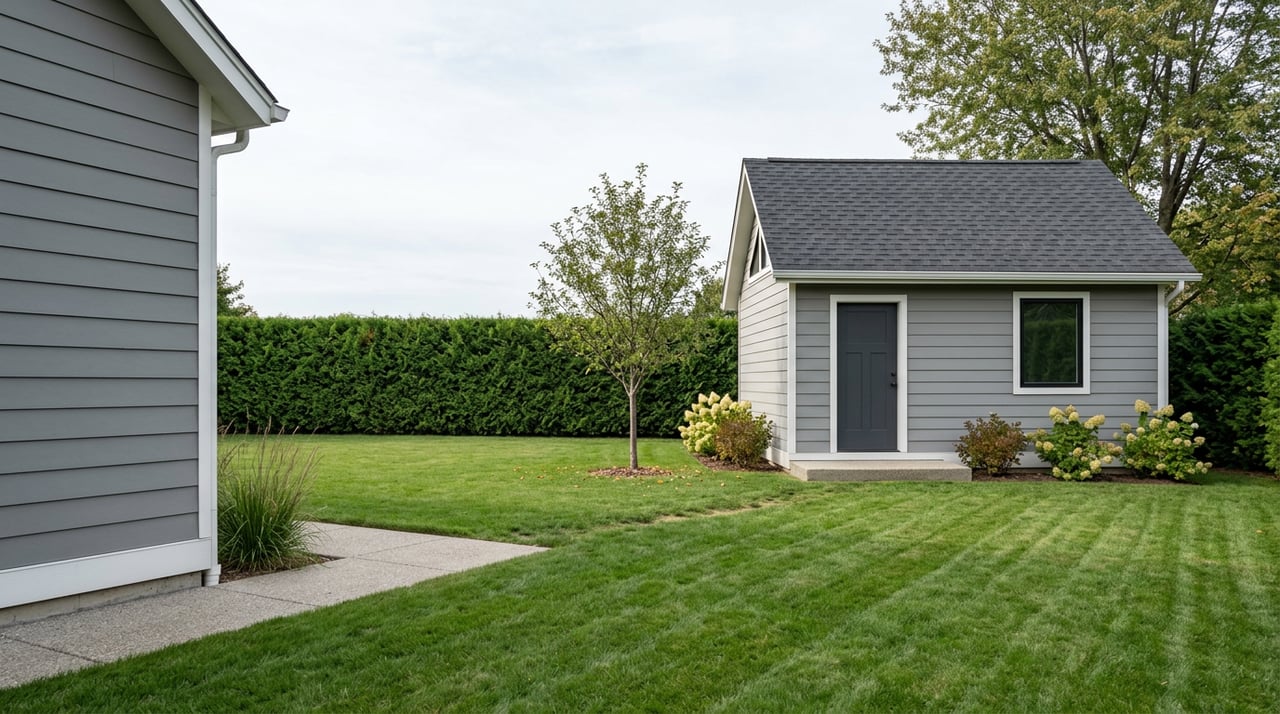
A homeowner calls Madison's Development Services Center with a plan: build a small detached unit in the backyard for a parent who needs to be closer, or a renter who'll help cover the mortgage. The zoning conversation is short. In most residential districts, the answer is yes, and there's no public hearing required. Then the plumbing contractor gets involved, and the project slows down for a reason that has nothing to do with city hall.
If the existing home and the new unit share a sewer lateral, the city will require a deed restriction before you can rent or sell them separately. If the water lateral doesn't have the capacity for two households, someone has to calculate the pressure drop and either upgrade the line or run a new one from the street. Madison Gas and Electric requires its own meter and service panel for each home on the lot. None of this shows up in a zoning map. It shows up in a contractor's estimate, usually after the homeowner has already told a relative or a renter that the plan is moving forward.
That gap between "the city allows it" and "here's what it actually costs to do it" is the real story behind accessory dwelling units in Madison right now, and it matters to more than the people already building one. It changes how you should think about a listing with in-law suite potential, a lot with a detached garage worth converting, or a family decision about where an aging parent moves next.
Madison got here years before most of Wisconsin
Madison started allowing backyard cottages in 2013, and the city has been loosening the rules around them ever since. Two changes matter most for anyone weighing a project today.
- January 2023: the city adopted a transit-oriented development overlay that allowed ADUs on single- and two-family properties within a quarter mile of Madison's bus rapid transit line, a step meant to add modest density near frequent transit.
- April 2024: the council removed the owner-occupancy requirement and extended ADU eligibility to lots with buildings of up to eight units, without a single person showing up to the meeting to object. Only one neighborhood group, the Vilas Neighborhood Association, put its opposition in writing beforehand.
Katie Bannon, Madison's zoning administrator, explained the logic at the time: "very few multifamily properties" with up to eight units "are owner-occupied," so keeping the requirement in place would have blocked the change from doing anything at all. AARP Wisconsin's Darrin Wasniewski spoke in favor of the update too, framing ADUs as a tool for helping older residents stay near family without taking on an entire second household's overhead.
The practical result is that Madison today allows ADUs as a permitted use on qualifying lots, meaning most projects skip the public hearing entirely, and the city has already worked through the owner-occupancy question that many Wisconsin municipalities haven't touched yet.
The state is trying to catch up to where Madison already is
That last point is worth sitting with, because Wisconsin lawmakers introduced a bill in 2025 that would require every city, village, and town with a zoning ordinance to allow at least one ADU as a permitted use on residential parcels with an existing single-family home. Senate Bill 473 was introduced on October 2, 2025, with a bipartisan slate of sponsors, and an amendment followed less than two weeks later addressing how far local governments could go in restricting short-term rentals inside new ADUs. As of the Legislative Council's February 2026 memo, the bill was still working through committee.
If it eventually passes, it will bring the rest of Dane County's towns and villages closer to a rulebook Madison finished writing years ago. For a buyer comparing Madison against a neighboring community specifically because of ADU potential, that's useful context: the flexibility you're shopping for in Madison may not stay a distinguishing feature of the city alone, but it's already fully in place there today, while it remains a legislative question mark almost everywhere else in the state.
The number that actually decides the project
Here's where the interpretation matters more than the zoning code. Madison's own Planning Division estimated in an April 2024 memo to the council that a detached ADU costs between $200,000 and $300,000 to build, a figure driven largely by foundation and utility work rather than finishes. Add to that a Parks Impact fee of roughly $4,500 per new unit, plus permit fees and any utility upgrades a lateral inspection turns up.
Set that against the market. In July 2026, the median sale price for a single-family home across the Dane County MLS was $514,900, up 2 percent from $505,000 a year earlier. A $200,000 to $300,000 build is not a minor line item next to that number. It's a project that can represent close to half the value of the underlying house, which means the decision to build one has to be judged against what it replaces, not just what it adds. For a family housing a parent, that comparison is against assisted living costs over several years. For an owner weighing rental income, it's against years of rent at whatever the local market supports. For a seller wondering whether ADU potential adds to a listing's appeal, it's a story to tell rather than a number to promise, since the buyer still has to run their own math on the build.
Madison does offer some help closing that gap. The city runs an ADU Loan Financing program tied to its Backyard Homes Project, aimed at property owners building affordable rental units, though eligibility requirements apply and are worth confirming directly with the city's community development office before counting on it.
The friction that catches people off guard
Coming back to where this started: the zoning approval is often the easy part now. The utility work is where projects lose weeks and budget. Madison's own guidance for detached ADUs spells out that a contractor must verify whether the existing water lateral can serve both buildings, and if it can't, either upgrade the line or install a new dedicated one. The city's water utility prefers a single meter per parcel, so a homeowner who wants separate metering for a future sale needs to plan for a new service line from the street, not just a splitter at the meter pit.
The sewer question carries its own long-term consequence. If both units end up on one shared lateral, the deed carries a restriction reflecting that, and separating the buildings for a future sale means paying a contractor to physically separate the sewer line first. None of this is a secret. It's published on the city's own site. It just rarely comes up until someone is already three weeks into a project and wondering why the timeline moved.
Who this actually matters for
- Families weighing a place for an aging parent. An ADU on the same lot keeps a parent close without asking anyone to sell a home or an existing tenant to move.
- Sellers with a detached garage or an underused basement. ADU potential can be a genuine feature of a listing, but it should be described honestly, with the buyer expected to verify utility capacity for their specific parcel rather than assuming the seller's estimate holds.
- Owners considering a small rental unit. The city's own single-unit financing program exists for exactly this use case, though it comes with eligibility rules worth confirming before a budget is built around it.
None of these decisions is really about the zoning map anymore. Madison settled that question years ago. What's left is the same math that shows up in any home improvement decision: what does it cost, what does it replace, and does the answer still work once the water and sewer contractor has been out to look at the lot.
A few common questions
Does every neighborhood in Madison follow the same ADU rules? Setback and lot coverage requirements vary by zoning district, and properties zoned Planned Development can carry additional restrictions. The city's zoning staff can confirm the rules for a specific parcel before any design work begins.
Can a new ADU be rented out as a short-term stay? That depends on how the pending state legislation and any future city ordinance updates land. Confirm current short-term rental rules with the city before making that part of the financial plan.
What if the lot already has a garage or an old accessory building? Garage conversions are permitted as long as the finished space meets building and zoning code, which is a different bar than the shell meeting code today. A contractor familiar with Madison's process can walk the lot and give a realistic answer before you commit to a design.
If you're weighing whether a property's ADU potential is worth pursuing, whether as a seller preparing to list or a buyer comparing options across Dane County, that's exactly the kind of question a second set of eyes helps answer before you're locked into a plan. Browning Real Estate Group works through these decisions with clients regularly and can help you think through what a property's layout, lot, and utility setup actually support. Request Your Home Valuation to start that conversation.